Launch offer — valid today only

HVAC and EPA 608 Prep, Finally in Order With Every Topic Drawn Step by Step!

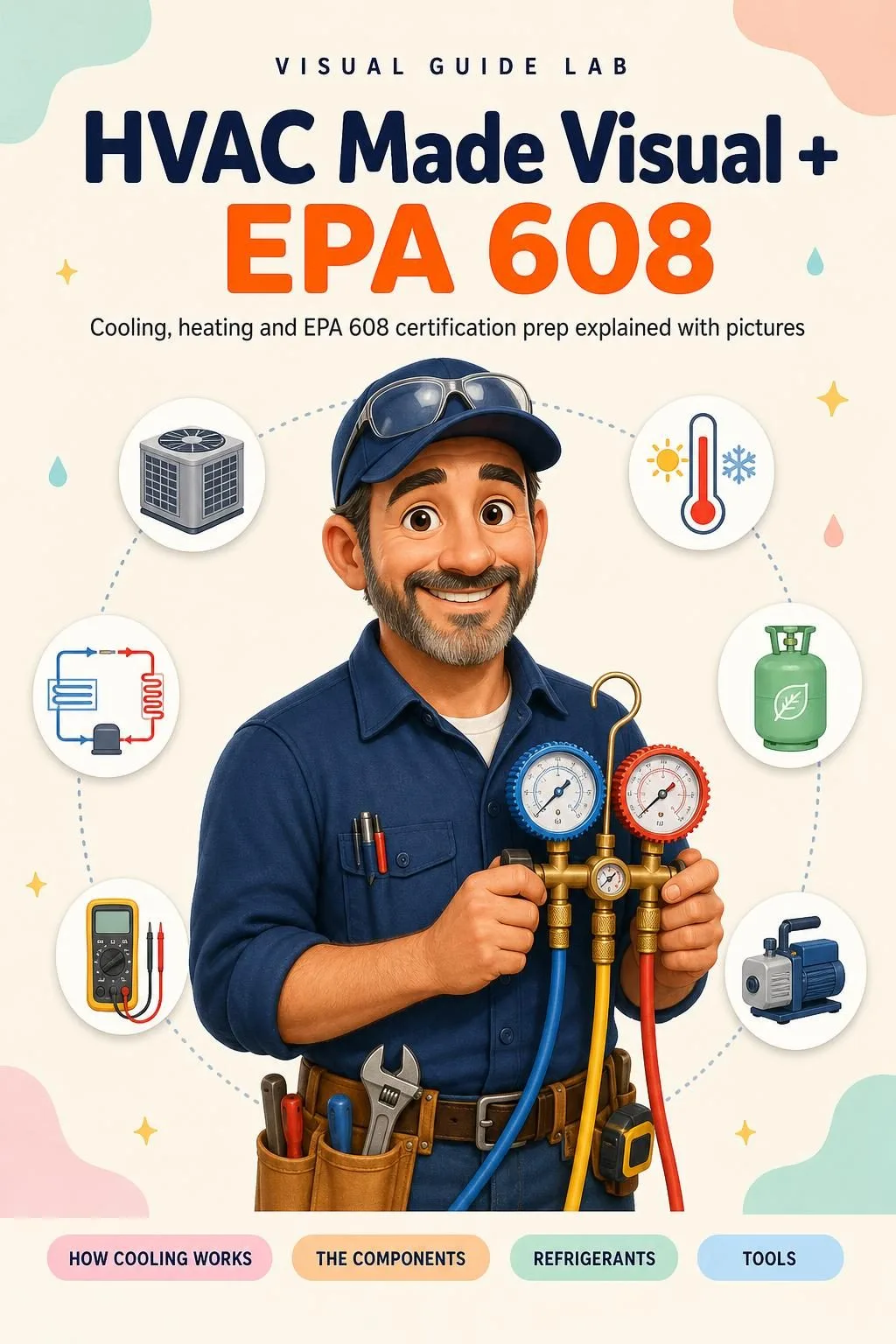
The refrigeration cycle, superheat and subcooling, evacuation, the gas furnace, A2L refrigerants like R-454B and R-32, and the EPA 608 rules: in your textbook it's a wall of text. Here every topic fits on one page, with the drawing and what you need to remember. 77 illustrated pages.

YES, I WANT THE ILLUSTRATED BOOK

🔒 Secure checkout · PDF by email · 30-day guarantee

One topic per pagethe drawing shows you how the system works and the text walks you through it
77 illustrated pages8 parts, from how cooling works to the final review
Up-to-date sourcesEPA Section 608 (40 CFR Part 82), AIM Act rules and ASHRAE 34

This Is What the Pages You Will Study Look Like

One topic per page, the drawing that shows you how it works and the boxes with what you need to know:

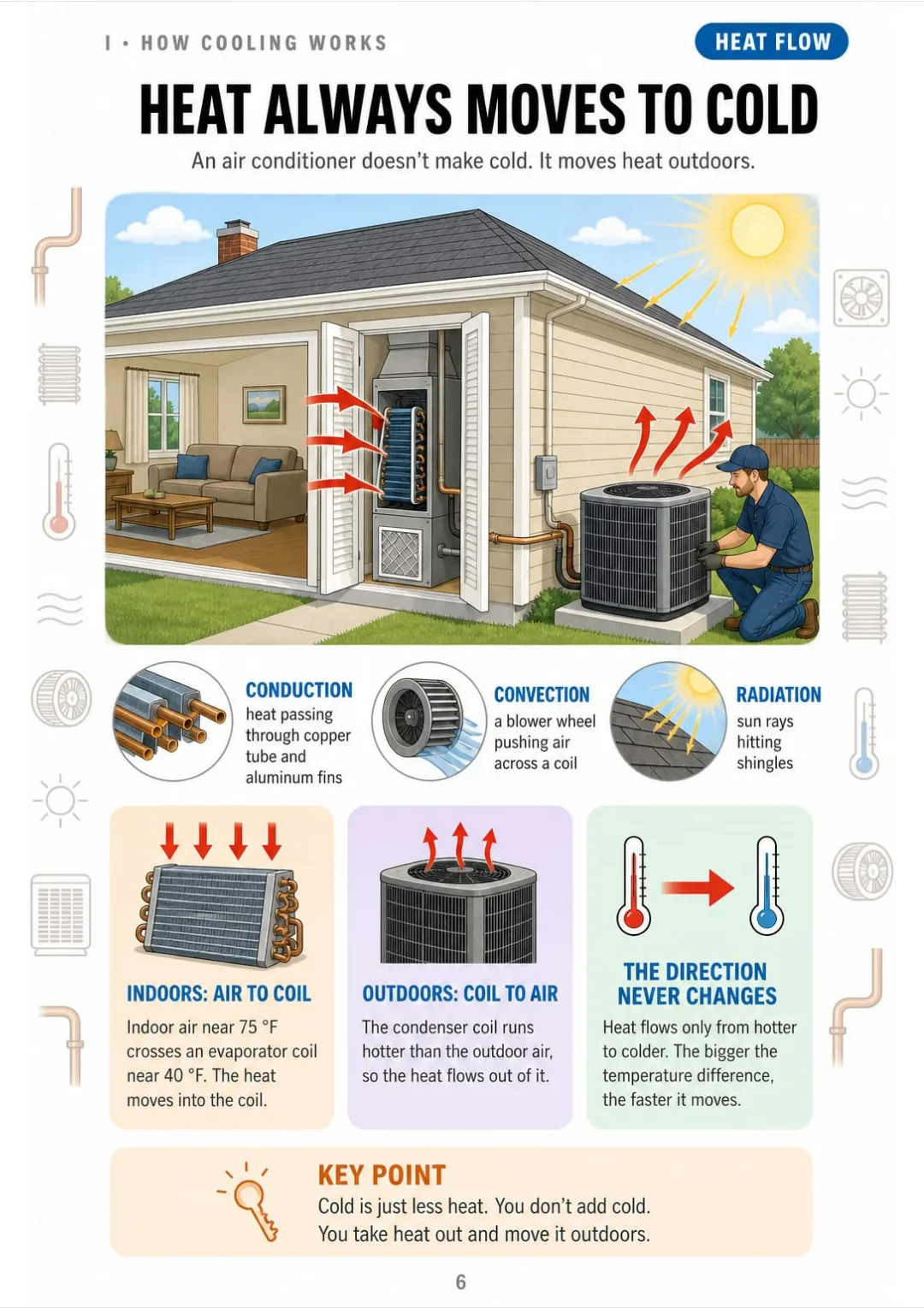
Heat flows from warm indoor air into the cold coil, and from the hot condenser into the outdoor air.
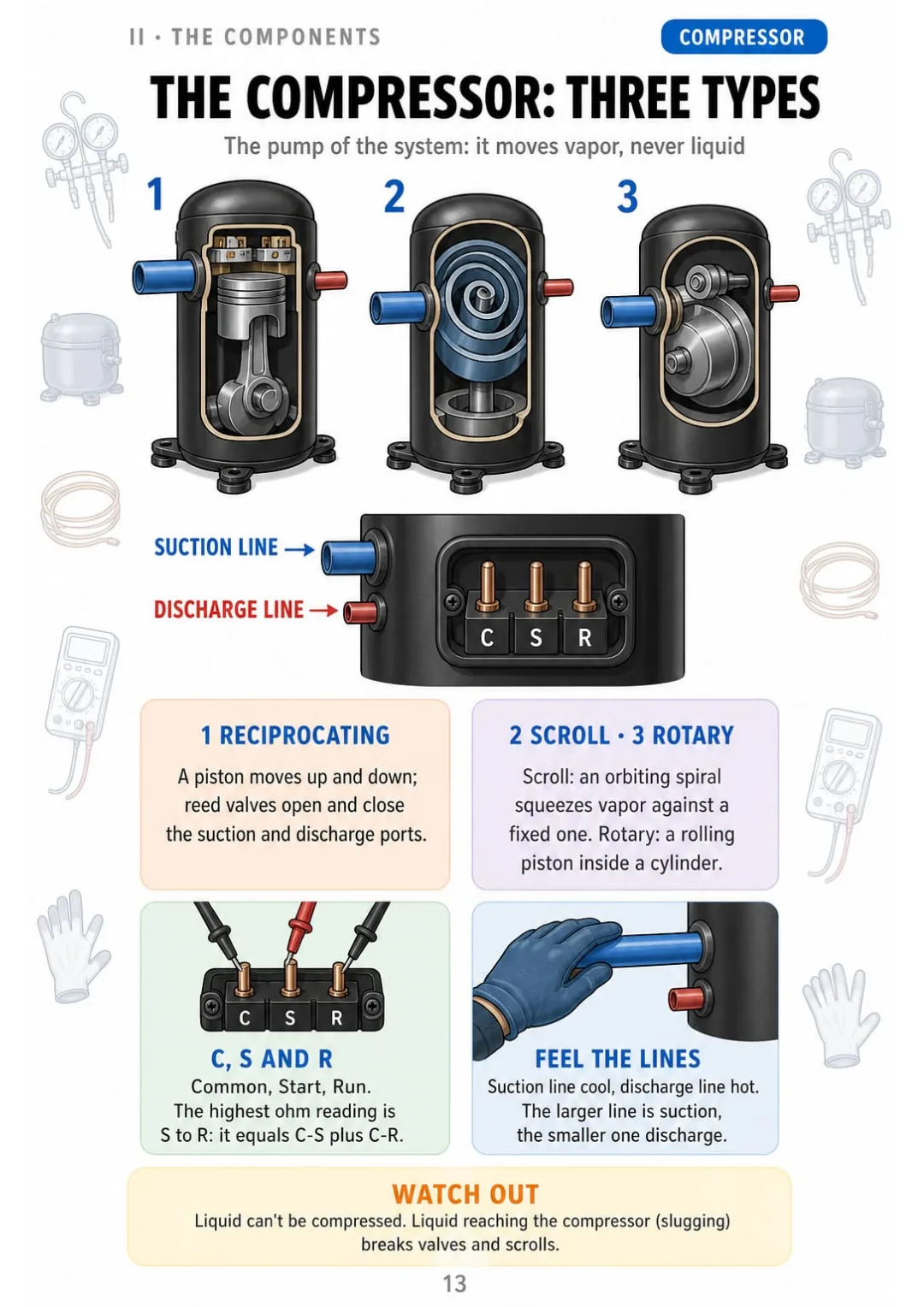
Reciprocating, scroll and rotary in cutaway, plus the C-S-R terminals measured with an ohmmeter.
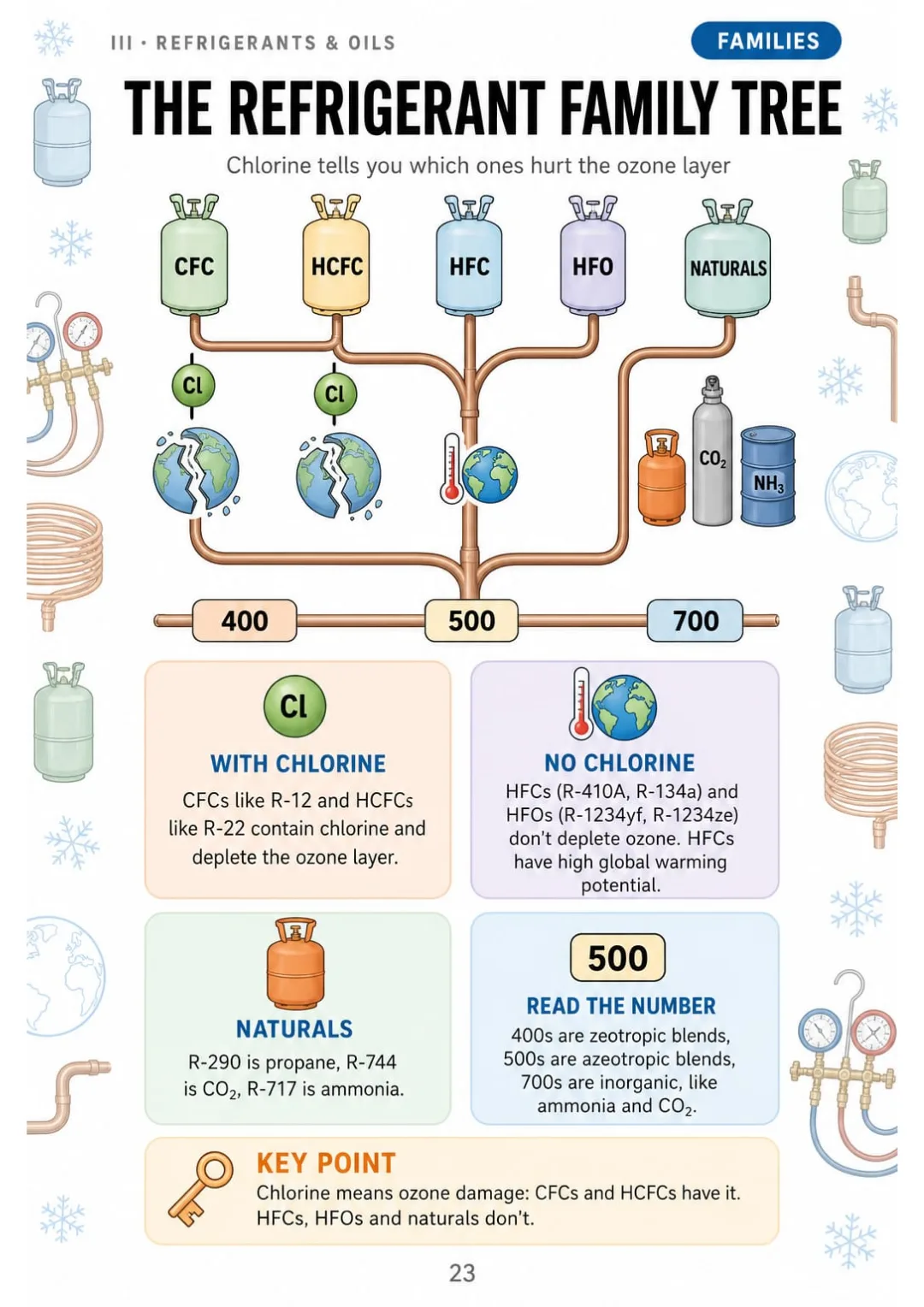
CFC and HCFC contain chlorine; HFC, HFO and naturals don't. 400 = zeotrope, 500 = azeotrope.
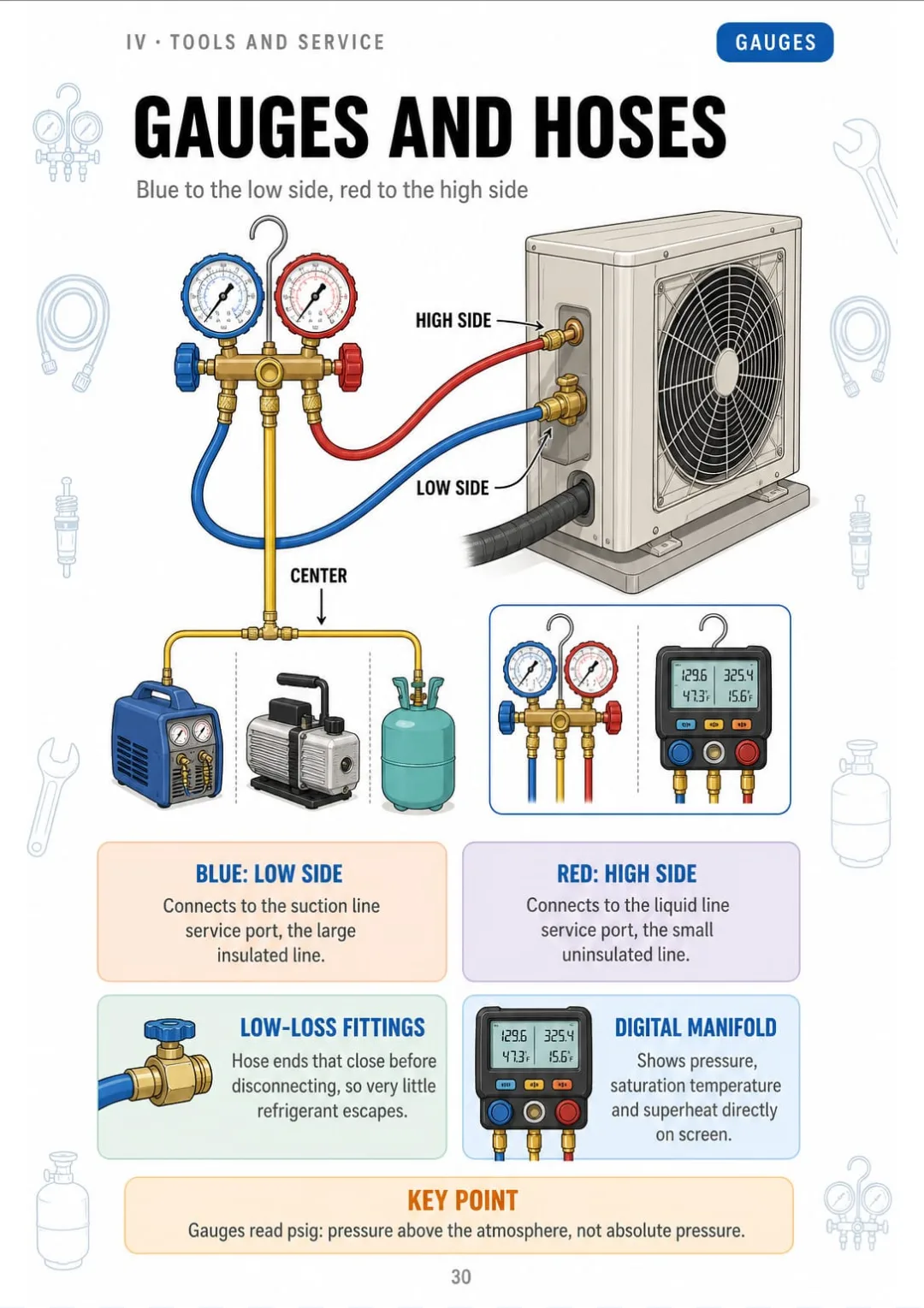
Blue hose to the suction port, red to the liquid line, yellow to the pump or cylinder.
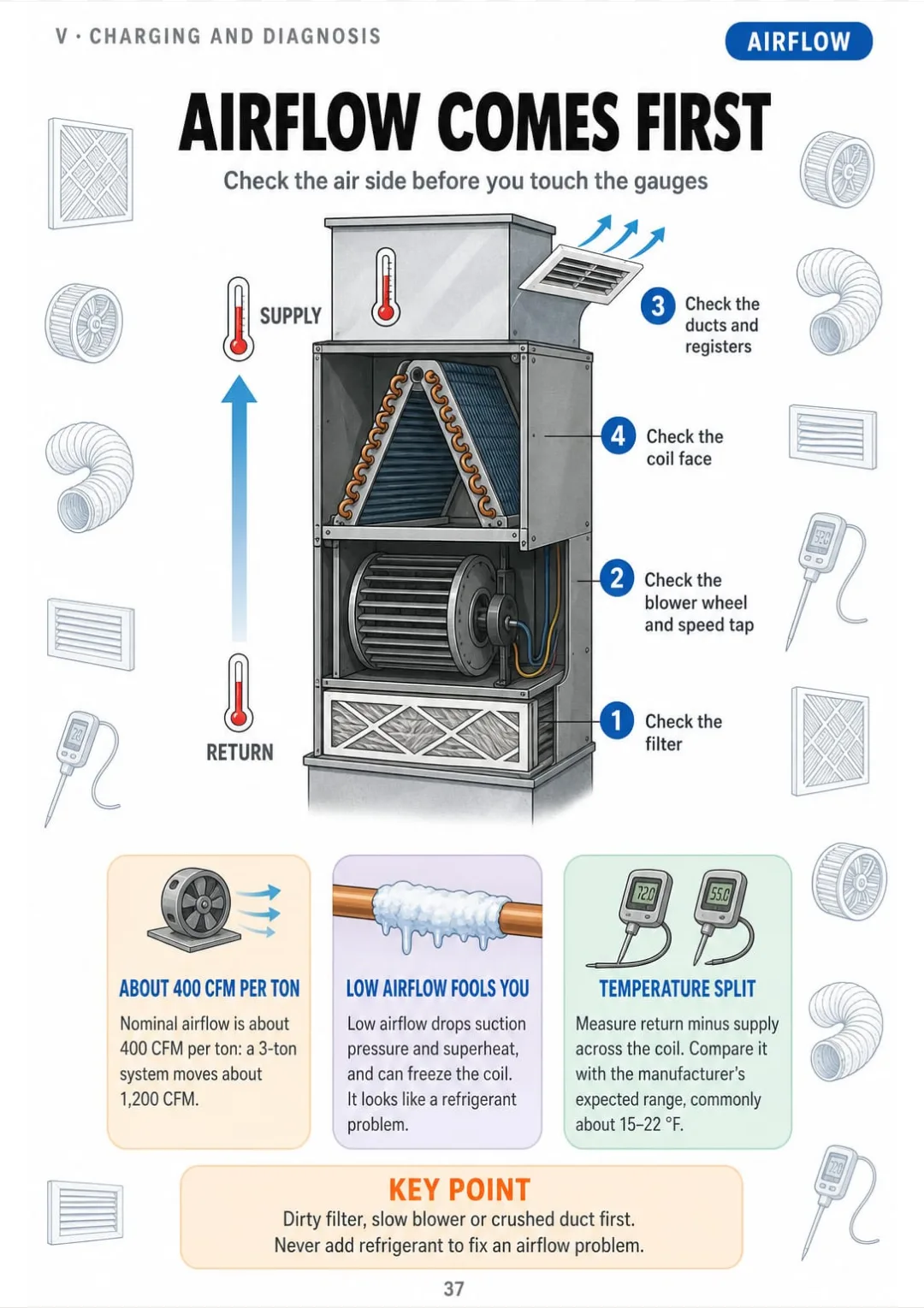
Airflow first: about 400 CFM per ton, checked before any refrigerant reading.
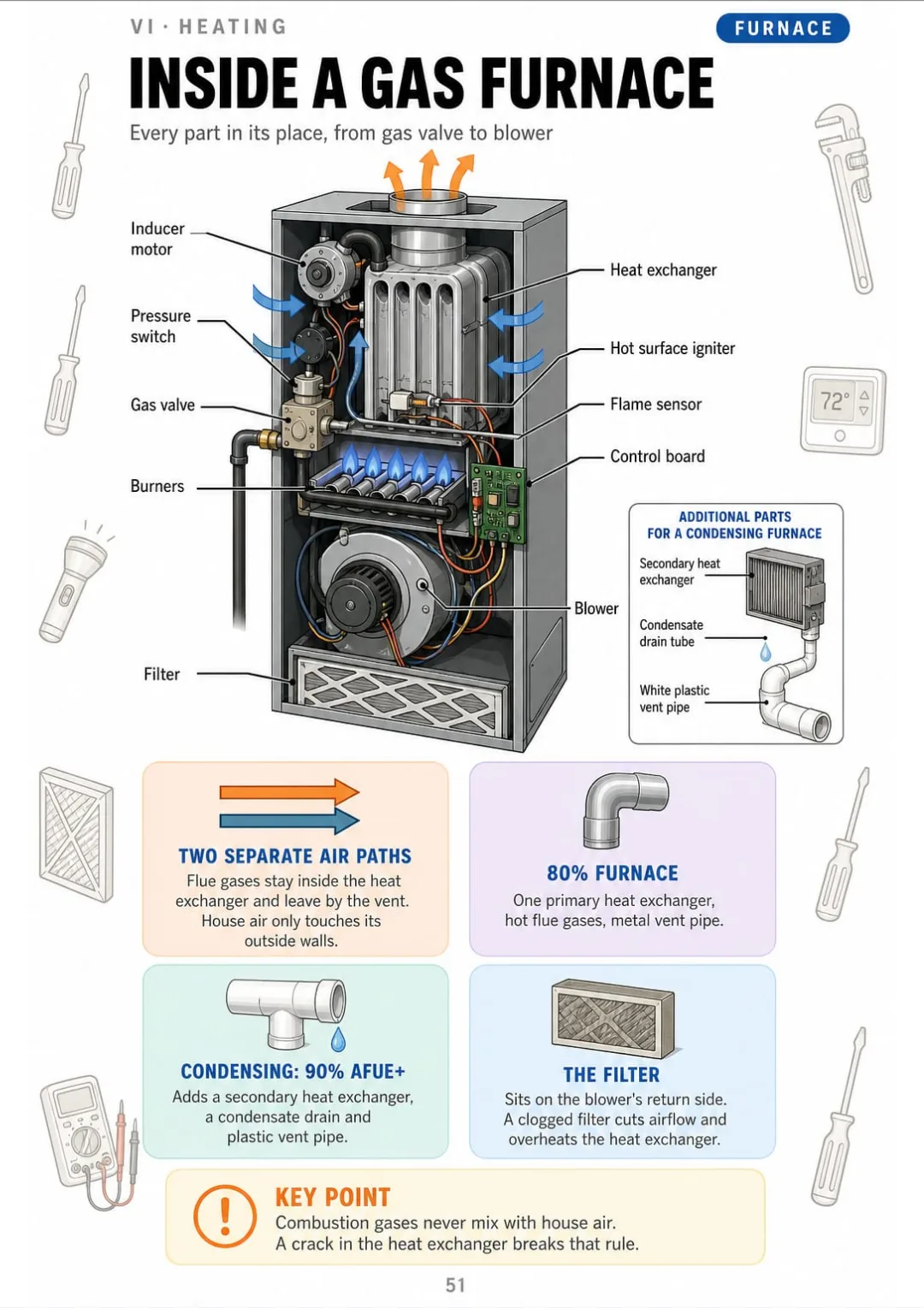
Gas furnace in cutaway: 10 parts labeled, plus what a 90% condensing furnace adds.
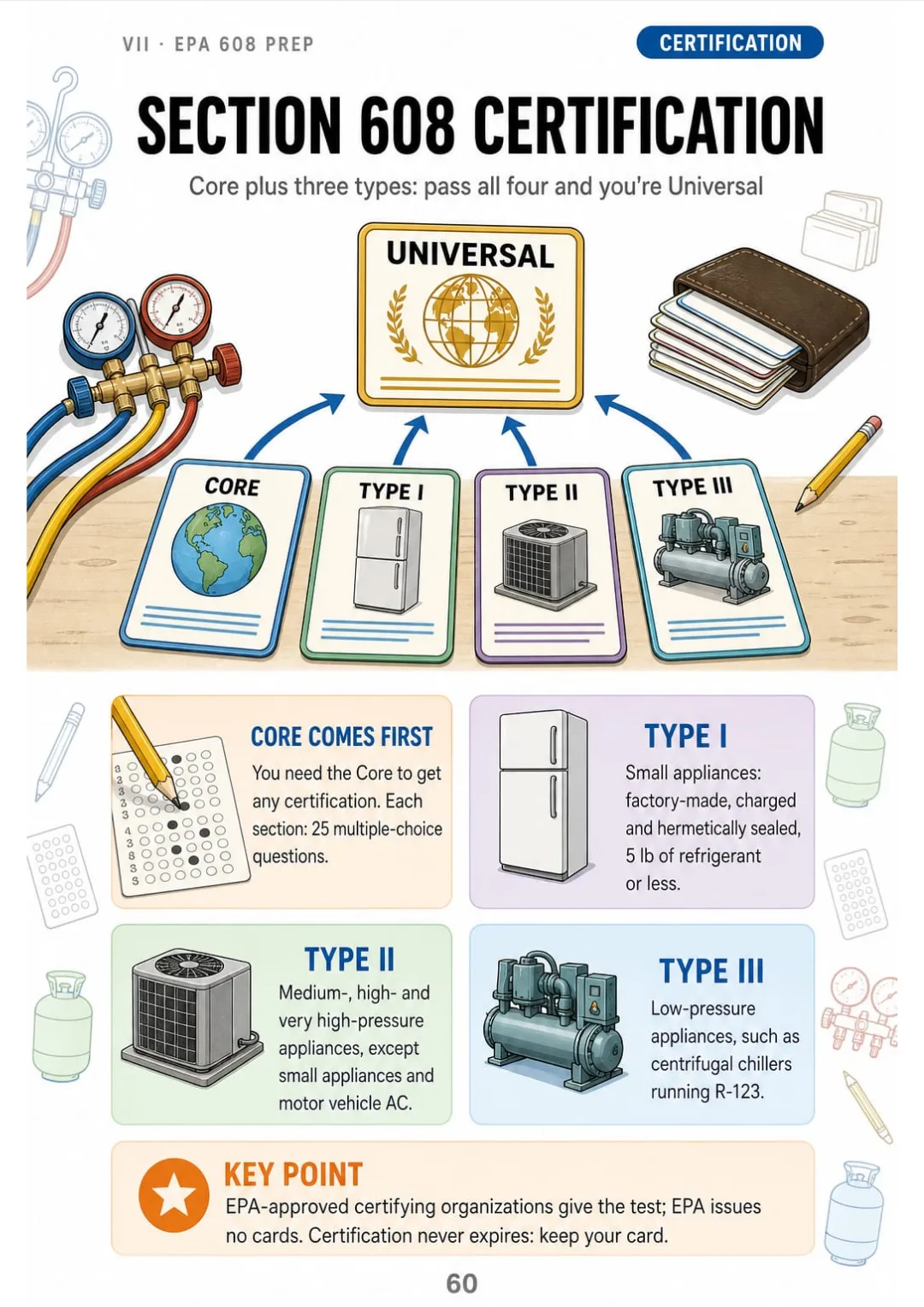
Core + Type I + Type II + Type III = Universal, 25 questions each
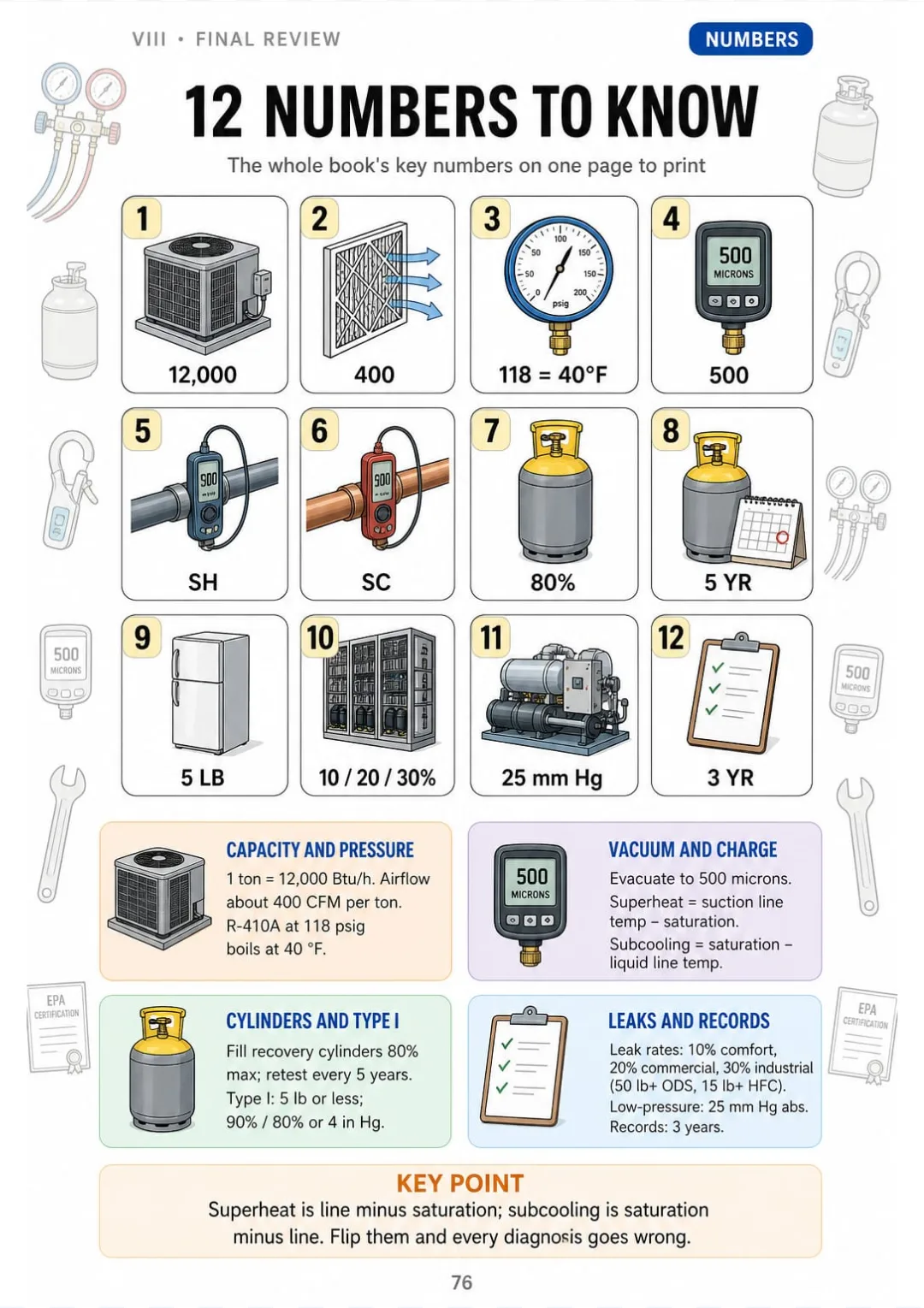
12 tiles: 12,000 Btu/h per ton, 400 CFM, 500 microns, 80% fill, 10/20/30% leak rates.

Swipe to see more →

These are real pages from the book. The table of contents is the full one: 8 parts and 72 topics.

It's Not That You Have a Bad Memory. It's That Nobody Put It in Order for You.

You've read three times which refrigerants are CFCs, HCFCs, HFCs and HFOs. You close the manual...

...and you can't remember which ones contain chlorine and which don't. It was just line after line.

CFC and HCFC contain chlorine; HFC, HFO and naturals don't. 400 = zeotrope, 500 = azeotrope.

Here the refrigerants are one family tree on a single page: CFCs and HCFCs on the chlorine branch, HFCs, HFOs and naturals on the other, and the 400 and 500 series sorted at a glance.

And on the pages next to it, every topic gets its own drawing: the refrigeration cycle, the gauges and hoses, airflow, the gas furnace and the recovery cylinder at 80%.

First you understand why it works that way. Then the order sticks on its own.

SEE THE DIFFERENCE

Stop memorizing components you can't picture:

THIS
  • Pages and pages of dense text
  • Components without a single drawing
  • On the exam, you don't know where to start
Compressors used in comfort cooling applications are classified according to their method of compression. The reciprocating compressor employs pistons driven by a crankshaft within cylinders, with suction and discharge valves regulating vapor flow. The scroll compressor consists of one stationary and one orbiting spiral, which progressively reduce the volume of trapped vapor pockets toward the central discharge port. The rotary compressor utilizes a rolling piston within a cylinder. Hermetic motor windings are identified as common, start and run, and resistance between terminals is verified with an ohmmeter.
FOR THIS
  • Every component drawn
  • One topic per page, with the rules in boxes
  • You remember it because you've seen it
Reciprocating, scroll and rotary in cutaway, plus the C-S-R terminals measured with an ohmmeter.
CONTENTS

Take a Look at the 8 Parts and 72 Topics

How cooling works, the components, refrigerants and oils, tools and service, charging and diagnosis, heating, EPA 608 prep and a final review: 77 pages, all illustrated

IHow Cooling Works · pp. 6-12
  1. Heat always moves to cold
  2. Btu, tons and capacity
  3. Sensible and latent heat
  4. Pressure and boiling point
  5. The refrigeration cycle
  6. High side and low side
  7. Review: How Cooling Works
IIThe Components · pp. 13-22
  1. The compressor
  2. The condenser
  3. Metering devices: piston and capillary tube
  4. Metering devices: TXV and EEV
  5. The evaporator and the air handler
  6. Driers, accumulators and service valves
  7. The heat pump and its reversing valve
  8. Contactor, capacitor and transformer
  9. The thermostat and its wires
  10. Review: The Components
IIIRefrigerants and Oils · pp. 23-29
  1. Refrigerant families
  2. Refrigerants you will meet
  3. Safety groups: A1, A2L and more
  4. Blends, glide and liquid charging
  5. Compressor oils
  6. Working with A2L refrigerants
  7. Review: Refrigerants and Oils
IVTools and Service · pp. 30-36
  1. Gauges and hoses
  2. Meters and temperature probes
  3. Brazing with nitrogen
  4. Pressure testing with nitrogen
  5. Evacuation and the micron gauge
  6. Finding leaks
  7. Review: Tools and Service
VCharging and Diagnosis · pp. 37-50
  1. Airflow comes first
  2. Measuring superheat
  3. Measuring subcooling
  4. Charging a piston system
  5. Charging a TXV system
  6. Weighing in the charge
  7. Reading the symptoms
  8. Low charge or restriction?
  9. Dirty condenser and non-condensables
  10. When the outdoor unit won't start
  11. Testing capacitors
  12. A frozen evaporator coil
  13. Condensate drains
  14. Review: Charging and Diagnosis
VIHeating · pp. 51-59
  1. Inside a gas furnace
  2. Sequence of operation
  3. Ignition and flame sensing
  4. Furnace safety switches
  5. Venting, combustion air and CO
  6. Heat pump heating and defrost
  7. Auxiliary and emergency heat
  8. Efficiency ratings
  9. Review: Heating
VIIEPA 608 Prep · pp. 60-75
  1. Section 608 certification
  2. Ozone and the Montreal Protocol
  3. The rules: venting, sales and records
  4. Recover, recycle, reclaim
  5. Recovery machines and cylinders
  6. Required evacuation levels
  7. Type I: small appliances
  8. Type II: high-pressure systems
  9. Type II: leak repair rules
  10. Type III: low-pressure chillers
  11. Practice: Core (1/2)
  12. Practice: Core (2/2)
  13. Practice: Type I
  14. Practice: Type II (1/2)
  15. Practice: Type II (2/2)
  16. Practice: Type III
VIIIFinal Review · pp. 76-77
  1. Final review (1): numbers to know
  2. Final review (2): quick diagnosis

What If Every Topic Fit on a Single Page?

Imagine this:

Instead of rereading half a page about superheat and subcooling without being able to picture them...

...you open the page and find the gauges on the high and low side, the probe on the line and a worked R-410A example, with the numbers in a box.

Airflow first: about 400 CFM per ton, checked before any refrigerant reading.

And the refrigeration cycle, metering devices, evacuation, the furnace sequence and the recovery rules turn into drawings and tables you can read at a glance.

You stop repeating and start understanding.

That's exactly what HVAC Made Visual + EPA 608 does. It's not “just another manual.” It's 77 pages in 8 parts, one illustrated topic per page, and inside the book, 30 original EPA 608 practice questions with explained answers and a final review. Because what your brain sees in order, it remembers.

Because what your brain sees organized, it remembers.

Here Is What You Get with HVAC Made Visual + EPA 608:

Ipp. 6-12

How Cooling Works

Why heat always moves to cold, Btu and tons, sensible and latent heat, pressure and boiling point, the refrigeration cycle and the high and low side.

IIpp. 13-22

The Components

The compressor, condenser, piston, cap tube, TXV and EEV, the evaporator and air handler, driers and service valves, the reversing valve, contactor, capacitor, transformer and thermostat wires.

IIIpp. 23-29

Refrigerants and Oils

Refrigerant families, the ones you'll meet in the field, safety groups A1 and A2L, blends and glide, compressor oils and working with A2L refrigerants.

IVpp. 30-36

Tools and Service

Gauges and hoses, meters and probes, brazing and pressure testing with nitrogen, evacuation with a micron gauge and finding leaks.

Vpp. 37-50

Charging and Diagnosis

Airflow first, then superheat and subcooling, charging piston and TXV systems, weighing in, one symptom table, low charge vs restriction, and the common calls from a unit that won't start to bad capacitors, frozen coils and clogged drains: so you read the system in the same order on every call.

VIpp. 51-59

Heating

Inside a gas furnace, the sequence of operation, ignition and flame sensing, safety switches, venting and CO, heat pump defrost, aux and emergency heat and efficiency ratings.

VIIpp. 60-75

EPA 608 Prep

Section 608 certification, ozone and the Montreal Protocol, venting, sales and records, recovery cylinders, evacuation levels, Type I, II and III and leak repair, plus Core, Type I, II and III practice questions.

VIIIpp. 76-77

Final Review

The numbers to know on one page and a quick diagnosis table, to review before the exam or a service call.

At the end of the book: 30 original EPA 608 practice questions with explained answers and a final review of the numbers to know.
And That Is Not All: 2 More Books, Free

HVAC Pocket Field Cards

BONUS 1: «HVAC Pocket Field Cards»

Value on its own: US$ 17.90

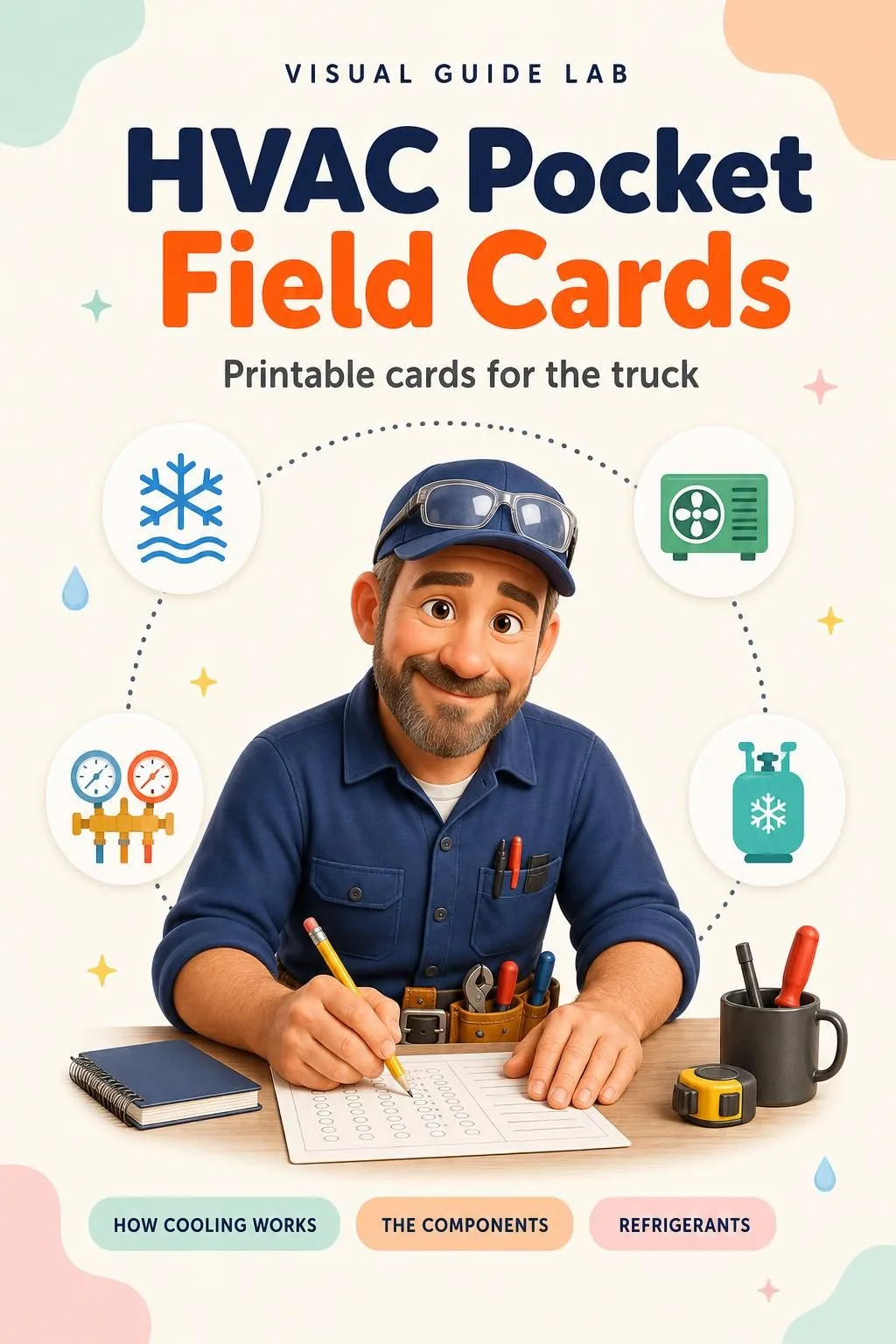
Printable cards for the truck: a pressure-temperature chart, superheat and subcooling quick checks and the furnace sequence of operation, to check a reading in seconds.

EPA 608 Practice Test

BONUS 2: «EPA 608 Practice Test»

Value on its own: US$ 14.90

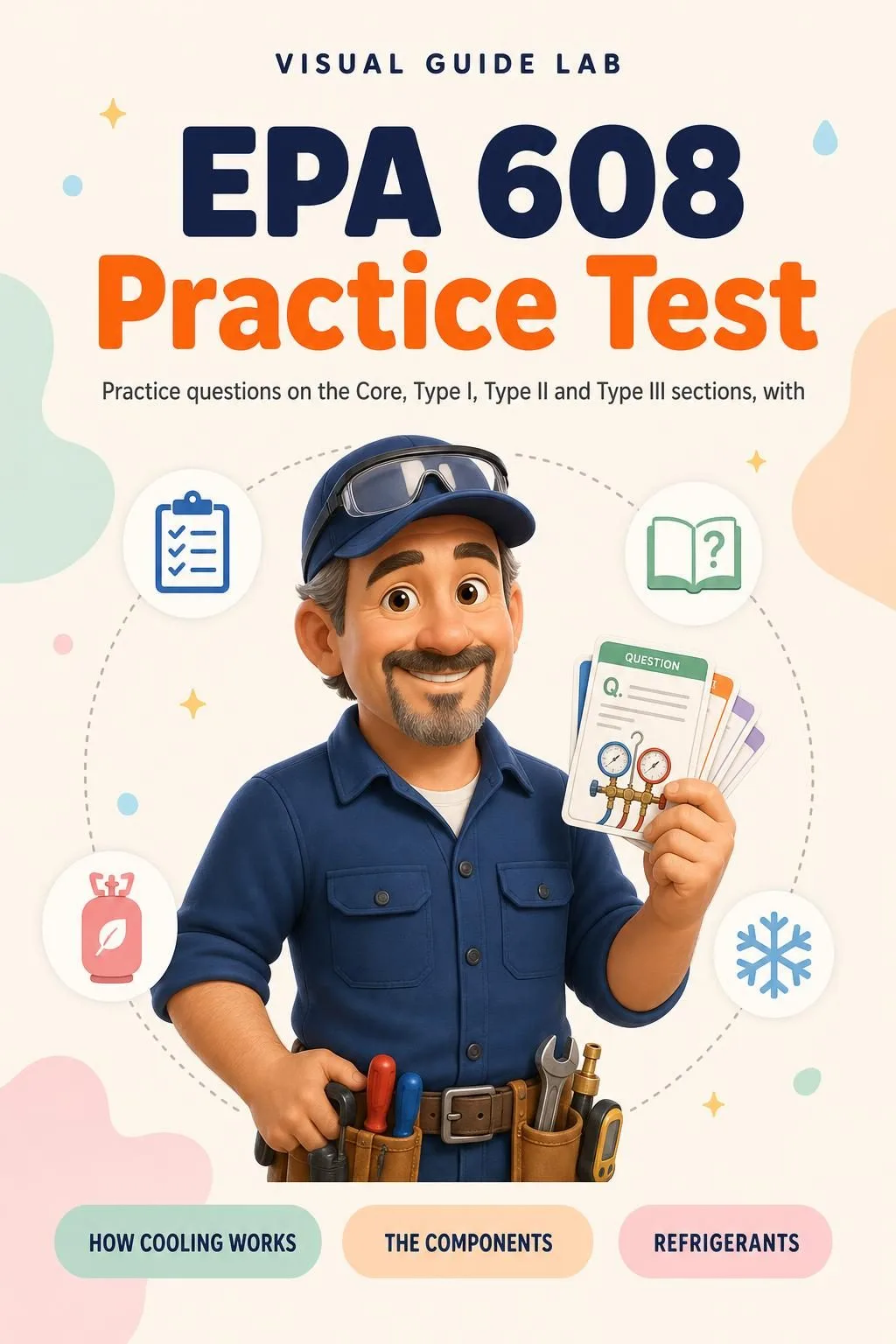
Practice questions on the Core, Type I, Type II and Type III sections, with every answer explained, so you know why it is right and what to reread when you miss one.

HVAC Made Visual + EPA 608 + 2 Free Books

  • HVAC Made Visual + EPA 608: 77 illustrated pagesUS$ 63
  • BONUS 1: HVAC Pocket Field CardsUS$ 17.90
  • BONUS 2: EPA 608 Practice TestUS$ 14.90
  • High-resolution PDF to printIncluded
Total value US$ 95.80
YOUR PRICE:
US$ 27
You save US$ 68.80
YES, I WANT HVAC MADE VISUAL + EPA 608 FOR US$ 27

📄 This is a digital PDF book sent to your email: nothing is printed or shipped.

Secure purchaseEncrypted payment30-day guarantee

PDF by email: HVAC Made Visual + EPA 608 reaches your inbox as a PDF, and the two free books come by email too. One-time payment, no installments or hidden costs.

Is This Book for You?

You're in HVAC school

You're in HVAC school

The cycle, the components and the controls, one topic per page, to review between classes and lab.

Your EPA 608 is coming up

Your EPA 608 is coming up

Core, Type I, II and III reviewed with drawings, and 30 original practice questions with every answer explained.

You're already in the field

You're already in the field

A quick refresher on what you do every day: airflow, superheat and subcooling, evacuation, furnace safeties and A2L refrigerants.

To Sum Up: Here Is What You Get

US$ 95.80US$ 27
YES, I WANT HVAC MADE VISUAL + EPA 608 FOR US$ 27

📄 This is a digital PDF book sent to your email: nothing is printed or shipped.

30DAYS
GUARANTEE

30-Day Guarantee

30-day guarantee: tell us what didn't work and we'll refund 100%.

You have 30 days to try HVAC Made Visual + EPA 608 and the two bonus books. If it doesn't work for you, email us, tell us what didn't work, and we'll refund 100% of what you paid. One-time payment, no subscriptions, no surprises.

Frequently Asked Questions

How do I get it?

After you pay, HVAC Made Visual + EPA 608 arrives as a high-resolution PDF sent to the email address you enter at checkout, to read on your phone or print. The two bonus books come by email too: HVAC Pocket Field Cards, to review the key numbers and checks before a call, and EPA 608 Practice Test, to practice Core, Type I, II and III on top of the questions in the book.

Is it a monthly or a one-time payment?

One-time payment of $27. No installments, no subscription.

Who is it for?

For HVAC school students and apprentices, for techs preparing for the EPA 608 (Core, Type I, II, III or Universal) and for techs already in the field who want a visual refresher. The basics take just a few pages and focus on the why: heat moving to cold, pressure and boiling point. The rest is what you use on calls and on the exam: gauges, airflow, superheat and subcooling, furnace safeties, A2L refrigerants and the 608 rules. Check the table of contents above.

What sources is it based on?

It's checked against the EPA Section 608 regulations (40 CFR Part 82, Subpart F) and the four sections of the 608 technician certification; the AIM Act HFC rules (40 CFR Part 84), including leak repair for HFC systems; ASHRAE Standard 34 safety groups; the International Mechanical Code for condensate; and manufacturers' installation instructions. It covers A2L refrigerants like R-454B and R-32 and how to work with them. EPA rules can change: before your exam, confirm the current version with your certifying organization.

Is this official EPA material?

No. It's an independent study book, not issued, approved or endorsed by the EPA, and it doesn't give you a certificate. Your EPA 608 card comes only from passing the exam with an EPA-approved certifying organization.

Does it replace HVAC school or my training?

No. It's a study and review companion. It doesn't replace your program, your apprenticeship, hands-on training, local codes or the manufacturer's instructions.

Are the practice questions the real exam questions?

No. They're written for this book and are not official EPA 608 exam questions. They're there to train you and show you what to reread.

Can I print it?

Yes. It's a PDF: read it on your phone or tablet, or print it and keep the field cards in the truck.

What if I don't like it?

30-day guarantee: tell us what didn't work and we'll refund 100%. One-time payment, no subscription.

One Last Thing Before You Decide...

You don't have to reread the same page hoping it sticks this time.

You don't have to memorize refrigerant rules you can't picture.

And you definitely don't have to walk into the exam not knowing where to start.

There's an easier way. And it's one click away. Now it's your turn.

One-time payment: US$ 27 · Guarantee: 30 days · PDF by email

YES, I WANT HVAC MADE VISUAL + EPA 608 FOR US$ 27

📄 This is a digital PDF book sent to your email: nothing is printed or shipped.